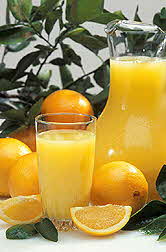
See also: Healthy Food Choices Videos How To Make Condensed O.J. Taste More Like FreshFlorida's citrus industry employs more than 100,000 people and contributes $8 billion a year to the state's economy. In addition to lemons, limes, tangerines, grapefruit, and other citrus, growers there raise and harvest over 200 million 90-pound boxes of oranges, on average, every year. Around 80 percent of them are processed, much of them into nutritious orange juice (O.J.)
Flavor is one of the most important qualities of O.J., and aroma compounds are significantly responsible for the fresh-squeezed taste consumers prefer. Unfortunately, those aroma compounds evaporate away during the condensing process used to make frozen concentrated orange juice. The aroma compounds—blended into mixtures—are sold to juice companies as "flavor packs" and are added back into the juice along with water before the juice is marketed. Photo by Scott Bauer.
 Finding the Source of Great TasteAt the ARS, researchers* are developing information about the thresholds of so-called flavor-impact aroma compounds that make fresh orange juice taste so good. A threshold is the minimum level at which a compound can be detected by smell or taste.
To improve O.J.'s flavor, it is necessary to unravel the interactions between all the compounds in juice, which is a complex mixture. In addition to flavor compounds, juice contains sugars, acids, pulp, pectin, salts, and phenolic compounds, which can influence perception of flavor. To understand interactions among the compounds and how they affect flavor perception, the researchers identified odor and taste thresholds of compounds considered to be important contributors to O.J. flavor. The researchers mixed the compounds into deodorized juice rather than water. The team solicited the help of some 50 nonprofessional taste testers.
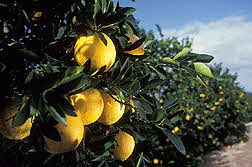
In evaluating various aroma compounds, volunteers were sent to a booth illuminated by red light, so they wouldn't be able to see and be influenced by a sample's color. The booth had positive outgoing air pressure so that outside smells couldn't get inside and affect the testers. Washington navel oranges growing in Florida.
Photo by Keith Weller.
 Each volunteer was then given 15 samples of chilled orange juice, distributed in 5 rows of 3 cups. In each row, two cups contained just deodorized O.J. and one cup contained juice spiked with a particular unidentified aroma compound. Each row differed in taste and odor intensity, with the top row containing the least amount of the compound and the bottom row the most. For each row, the volunteers had to smell the cups, guess which one was spiked with a compound, and describe the smell. Then, they had to sip through the rows and do the same for taste.
Responses differed greatly. Various compounds were described as smelling or tasting like paint thinner, fruit, mothballs, gasoline, pineapple, citrus, cheesy feet, musty, earthy, roses, lilacs, and even cotton candy. Why Test Both Smell and Taste?"Your taste buds may be on your tongue, but aroma compounds are perceived by the olfactory bulb in your nose. It's accessed through the front of the nose or through the back of your throat when food enters the mouth," explains researcher Elizabeth Baldwin. "This combined orthonasal (smelling through the front of the nose) and retronasal (the aroma going to the nose through the back of the throat) olfactory testing is really important to those in the citrus industry who are trying to formulate flavors."
The O.J. matrix contains well over 40 detectable compounds. Research at the Winter Haven facility over the last 40 years has determined that terpenes, alcohols, esters, and aldehydes are the compounds that are by far the most valuable when determining the best tasting O.J. Aldehydes and esters proved to be what Baldwin refers to as the "top-note" compounds, while terpenes provide the background. Now the O.J. scientific team is trying to find out what relative amounts of these types of compounds are needed to get that fresh-squeezed taste into reconstituted O.J.
Developing flavor packs that more closely mimic fresh juice flavor would improve the desirability of U.S. processed orange juice and help it better compete in the global marketplace.
*ARS Citrus and Subtropical Products Laboratory in Winter Haven, Florida, Elizabeth Baldwin, horticulturist and research leader, chemist Kevin Goodner, project leader of the flavor group, and chemist Anne Plotto.
So far, giant juice companies like Tropicana, Coca-Cola North America (makers of Minute Maid juices), Florida's Natural, and Cargill Citro-America have all shown interest in this project and have offered to help find sources of O.J. aroma compounds to help Baldwin and her team. Flavor companies Kerry Food Ingredients and Danisco Cultour have also been supportive.
Providing scientific and technical support have been Rene Goodrich, a professor at the University of Florida's Citrus Research and Education Center in nearby Lake Alfred, and the Florida Citrus Processors Association.
This research is part of Quality and Utilization of Agricultural Products, an ARS National Program
Elizabeth A. Baldwin is at the USDA-ARS Citrus and Subtropical Products Laboratory, Winter Haven, FL
"New Ways To Make Condensed O.J. Taste More Like Fresh" was published in the September 2004 issue of Agricultural Research magazine.
By Alfredo Flores, Agricultural Research Service Information Staff.
Agricultural Research Service, USDA: ( www.ars.usda.gov )
ARS is the U.S. Department of Agriculture's chief scientific research agency.
|