FoodReference.com Logo

Food Articles, News & Features Section

Home   |    FOOD ARTICLES   |    Food Trivia & Facts   |    Today in Food History   |    Cooking Tips   |    Recipes   |    Food Quotes   |    Who's Who   |    Videos   |    Trivia Quizzes   |    Crosswords   |    Food Poems   |    Food Posters   |    Cookbook Reviews   |    Shopping   |    Culinary Schools   |    Gourmet Tours   |    Food Festivals & Food Shows

You are here 

> Home  > Food Articles  > Organic, Local & Ethical Foods  > ----Innovation: Toilet Compost Fertilizer

Next


CULINARY SCHOOLS &
COOKING CLASSES

From Amateur & Basic Cooking Classes to Professional Chef Training & Degrees -  Associates, Bachelors & Masters
More than 1,000 schools & classes listed for all 50 States, Online and Worldwide


Culinary Posters and Art


Composting Toilets for Urban Farmers


Providing an Agricultural Answer to Nature’s Call

It’s hard to believe, but an estimated 2.6 billion people in the developing world—nearly a third of the global population—still lack access to basic sanitation services. This presents a significant hygiene risk, especially in densely populated urban areas and slums where contaminated drinking water can spread disease rapidly. Every year, some 1.5 million children die from diarrhea caused by poor sanitation and hygiene.

It is in these crowded cities, too, that food security is weakened by the lack of clean, nutrient-rich soil as well as growing space available for local families.

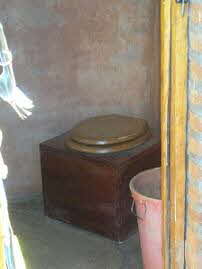
composting toilet

In Malawi, Stacia and Kristof Nordin's composting toilet fertilizes their crops. (Photo credit: Bernard Pollack)

But there is an inexpensive solution to both problems. A recent innovation, called the Peepoo, is a disposable bag that can be used once as a toilet and then buried in the ground. Urea crystals in the bag kill off disease-producing pathogens and break down the waste into fertilizer, simultaneously eliminating the sanitation risk and providing a benefit for urban gardens. After successful test runs in Kenya and India, the bags will be mass produced this summer and sold for U.S. 2–3 cents each, making them more accessible to those who will benefit from them the most.

In post-earthquake Haiti, where many poor and homeless residents are forced to live in garbage heaps and to relieve themselves wherever they can find privacy, SOIL/SOL, a non-profit working to improve soil and convert waste into a resource, is partnering with Oxfam GB to build indoor dry toilets for 25 families as well as four public dry toilets. The project will establish a waste composting site to convert dry waste into fertilizer and nutrient-rich soil that can then be used to grow vegetables in rooftop gardens and backyards.

In Malawi, Stacia and Kristof Nordin’s permaculture project (which Nourishing the Planet co-director Danielle Nierenberg visited during her tour of Africa) uses a composting toilet to fertilize the crops. Although these units can be expensive to purchase and install, one company, Rigel Technology, manufactures a toilet that costs just US$30 and separates solid from fluid waste, converting it into fertilizer. The Indian non-profit Sulabh International also promotes community units that convert methane from waste into biogas for cooking.

On a larger scale, wetlands outside of Calcutta, India, process some 600 million liters of raw sewage delivered from the city every day in 300 fish-producing ponds. These wetlands produce 13,000 tons of fish annually for consumption by the city’s 12 million inhabitants. They also serve as an environmentally sound waste treatment center, with hyacinths, algal blooms, and fish disposing of the waste, while also providing a home for migrating birds and an important source of local food for the population of Calcutta.
(See also “Fish Production Reaches a Record.”)

Aside from cost and installation, the main obstacles to using human waste to fertilize crops are cultural and behavioral. UNICEF notes in an online case study that a government-run program in India provided 33 families in the village of Bahtarai with latrines near their houses. But the majority of villagers still preferred to use the fields as toilets, as they were accustomed to doing their whole lives. “It is not enough just to construct the toilets,” said Gaurav Dwivedi, Collector and Bilaspur District Magistrate. “We have to change the thinking of people so that they are amenable to using the toilets.”

Molly Theobald
Nourishing the Planet blog www.nourishingtheplanet.org


TOP


RELATED ARTICLES:

U.S. Consumption Habits     |     Is Organic Food Healthier?     |     What are the Growing Green Awards?     |     Sustainable Food & Organic Farming     |     Organic Food Health Benefits Research     |     Health & Safety Advantages of Organic Food     |     Good Food Awards Entries     |     Sustainability Award Winners 2012     |     Protein Sources & Environmental Impact     |     Agriculture Report Highlights Organic Sector     |     Canada’s Organic Rules     |     Bananas & Rainforests     |     Bulk Foods Are Green     |     Chicken, Organic Pasture Raised     |     Cow Pies to Clear Skies     |     Eating Locally & the Environment     |     Eco Friendly Dinnerware     |     Fast Food Recycling     |     Fish, What to Avoid     |     Garlic: California or China?     |     Generation Organic     |     Genetically Engineered Alfalfa     |     Labeling GM Foods: Prop 37 Defeat     |     Local Food and Supermarkets     |     Local or Organic? A False Choice     |     Local or Organic? pg 2    |     Location, Location, Location     |     Nourishing The Planet Innovations     |     ----Drip Irrigation Innovation     |     ----Innovation: Toilet Compost Fertilizer     |     Organic Farming     |     Organic Foods Reduce Cancer Risk     |     Organic Food Sales Increase     |     Organic Foods     |     Organic Labeling & Cloned Animals     |     Organic Foods Guide     |     Pros and Cons of Biofuels     |     Reverse Trick or Treating     |     Seattle's Flying Fish Restaurant     |     Slow Food     |     Sustainable: What does it mean?     |     Sugar, Sustainable Sugars     |     Think Globally, Act Locally pg 1     |     Think Globally, Act Locally pg 2


Home     |     About Us & Contact Us     |     FOOD ARTICLES     |     Website Bibliography     |     Food Timeline     |     Other Food Links

Please feel free to link to any pages of FoodReference.com from your website.

For permission to use any of this content please E-mail: james@foodreference.com
All contents are copyright © 1990 - 2013 James T. Ehler and www.FoodReference.com unless otherwise noted.
All rights reserved.     You may copy and use portions of this website for non-commercial, personal use only.
Any other use of these materials without prior written authorization is not very nice and violates the copyright.

Please take the time to request permission.


POPULAR PAGES

  Beverage Articles
  Food Facts & Trivia
  Recipe Contests
  Food Shows & Festivals
  Recipe Category Index


Click here to buy posters at Allposters!


FOOD VIDEO SECTION
Recipe Videos, BBQ & Grilling, Food Safety, Food Science, Food Festivals, Beverages, Vintage Commercials, etc.


Order Free Food & Kitchen Catalogs


FREE Food & Beverage Publications
An extensive selection of free magazines and other publications for qualified Food, Beverage & Hospitality professionals