See also: Article on Apricots
APRICOTS
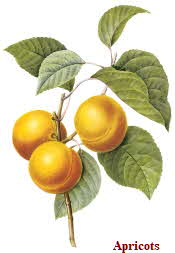
The apricot (Prunus armeniaca) a native of China, has been cultivated for over 4,000 years.
In the United States, 95% of apricots grow in the San Joaquin Valley and other parts of northern California.
Apricot trees are hardy, drought resistant and long lived (100 years plus) but the fruit is highly perishable and for full-flavor must be tree ripened. Fresh ripe apricots are very soft and do not ship well. Less than 10% are sold fresh; most of the crop being canned, dried or used in preserves.
In 1778 Thomas Jefferson was growing apricot trees at Monticello.
Average apricot trees rise to 12-15 feet tall and produce fruit for 20-25 years

Apricots originally came from China. This golden fruit has been around for more than 4,000 years. Apricots progressively made their way through the Persian Empire to the Mediterranean where they were fondly adopted. Spanish explorers introduced the apricot to the New World, and they were planted in the gardens of Spanish missions all over California. The first recorded major production of apricots in America was in 1792 south of San Francisco.
In Latin, apricot means 'precious,' a label earned because it ripens earlier than other summer fruits. A relative of the peach, the apricot is smaller and has a smooth, oval pit that falls out easily when the fruit is halved.
California harvested 77,300 tons of apricots in 2003.
Also see: Food Articles and Cooking Tips
You are here > Home >
Please feel free to link to any pages of FoodReference.com from your website.
For permission to use any of this content please E-mail: james@foodreference.com
All contents are copyright © 1990 - 2025 James T. Ehler and www.FoodReference.com unless otherwise noted.
All rights reserved. You may copy and use portions of this website for non-commercial, personal use only.
Any other use of these materials without prior written authorization is not very nice and violates the copyright.
Please take the time to request permission.
FOOD TRIVIA and FOOD FACTS

Popular Pages
CULINARY SCHOOLS
& COOKING CLASSES
From Amateur & Basic Cooking Classes to Professional Chef Training & Degrees
Home | Articles | FOOD TRIVIA | Today in Food History | Food_Timeline | Recipes | Cooking_Tips | Food Quotes | Who’s Who | Culinary Schools and Tours | Food_Trivia_Quizzes | Food Poems | Free Magazines | Food Festivals & Events
FoodReference.com (since 1999)
FOOD TRIVIA and FOOD FACTS SECTION